Time Calculator
Grab the tip of each clock's hour, minute, and second hands to set the time, then add or subtract.
First Time
00:00:00Second Time
00:00:00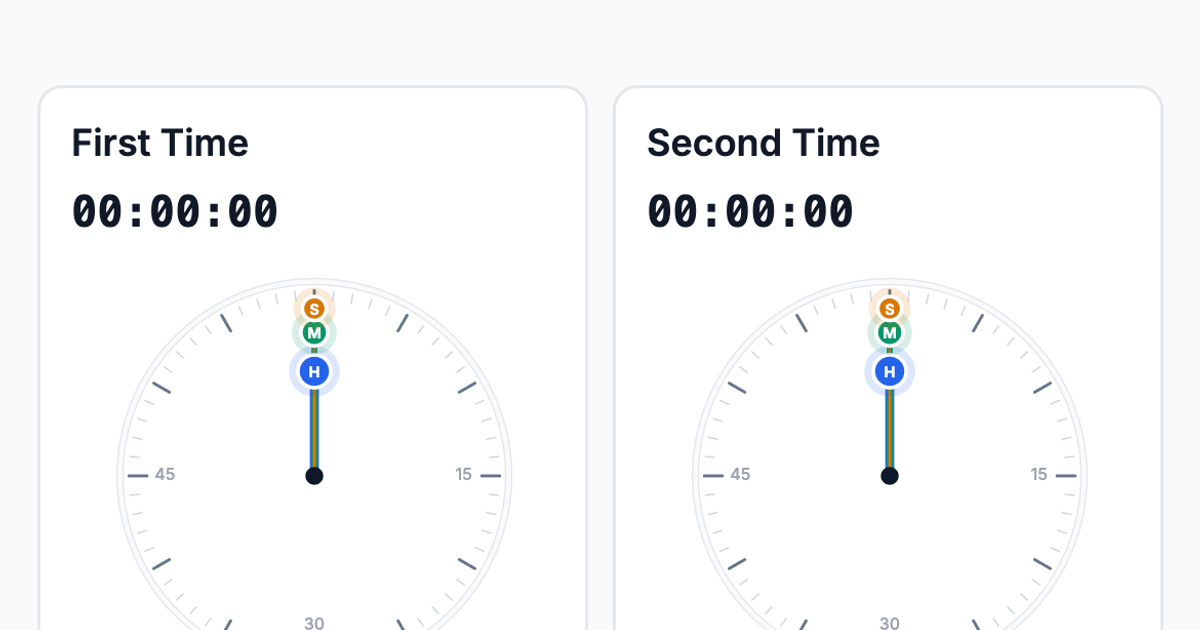
What is a Time Calculator?
A time calculator is a free online tool that adds or subtracts hours, minutes, and seconds, or computes the difference between two times. Use it for work-hour reconciliation, cumulative workout or study time, cooking timers, project scheduling, and time-zone conversions. No install, no sign-up, runs directly in your browser.
How to use
1. Enter both times
Set the first and second time in hours, minutes, and seconds, or drag the clock hands into place.
2. See add and subtract together
The add and subtract results appear on the same screen without switching modes.
3. See the result
Change any value and the result updates automatically in hours, minutes, and seconds. If subtraction would be negative, a warning is shown.
Time Addition and Subtraction Use Cases
How to Use the Add Time Calculator
Enter two durations to instantly add study time, workout time, work sessions, or task blocks. Results can exceed 24 hours, so longer projects and weekly totals are supported.
How to Use the Subtract Time Calculator
Subtract break time, waiting time, or unused time from a total duration. If the second value is larger than the first, the page shows a negative-result notice.
Hours, Minutes, and Seconds Conversion
The calculator converts hours, minutes, and seconds into seconds internally, then formats the answer back into readable time units with total seconds.
Alternative to Spreadsheet Time Math
For quick time addition and subtraction, this browser calculator avoids spreadsheet formulas. Use the work hours calculator for repeated timesheet-style calculations.
Use cases
Work hour reconciliation
Compute the difference between clock-in and clock-out to account for actual and overtime hours accurately.
Workout and study tracking
Sum multiple sessions per day to see weekly or monthly totals.
Cooking and baking timers
Add the durations of overlapping cooking steps and back-calculate when dishes will be ready.
Project scheduling
Add estimated task durations for a total finish time, then subtract buffer time to check slack.
Travel and time zones
Add the time-zone offset and flight duration to estimate local arrival time before departure.
Time unit reference
- 1 hour = 60 minutes = 3,600 seconds
- 1 day = 24 hours = 1,440 minutes = 86,400 seconds
- 1 week = 7 days = 168 hours = 10,080 minutes
- 1 year (365 days) = 8,760 hours = 525,600 minutes
Frequently asked questions
Does the subtraction mode support negative results?+
Negative results are detected and shown as a warning instead of a negative duration. If you need that difference, swap the first and second times.
Can it handle results over 24 hours?+
Yes. Totals beyond 24 hours are preserved and shown as 25:30:00 or similar. Useful for long projects or cumulative work hours.
How do I use the time addition mode?+
Enter both times and the addition result updates immediately. It works well for accumulating study, workout, or cooking durations across multiple sessions.
Is it accurate to the second?+
Yes. Hours, minutes, and seconds are accepted, and calculations run on the second internally, so there is no loss of precision.
Does it work on mobile?+
Yes. The layout is responsive and works on mobile browsers. No app install required.
Can I use this instead of spreadsheet formulas?+
Yes. For quick addition, subtraction, and hour-minute-second conversion, the web calculator is faster than writing spreadsheet formulas.
Can it convert minutes and seconds into hours?+
Yes. Minutes and seconds are converted into seconds internally and then displayed as hours, minutes, and seconds.
Related Time Calculators
Time compounds — it applies to investing, too
If this calculator handles minutes in daily life, time in investing is the most powerful asset of all, amplified by compounding. The same amount invested for 10 years versus 30 years can differ by multiples, so a target-aware asset allocation and regular rebalancing are essential.
Apply the compounding of time to your assets→Continue From Time Arithmetic
After adding or subtracting hours and minutes, move to work hours, presentation timing, sleep planning, or world time conversion when the task needs more context.
- Use work hours when break time and weekly totals matter.
- Use presentation timing for script and slide estimates.
- Use world time for Korea, US, UTC, and daylight saving conversions.