Budichhida vs. Budicheoda: Korean Collision Verbs Explained
When something collides or runs into something, Korean uses either 'budichhida' (부딪히다) or 'budicheoda' (부딪치다) — but do you know which one to use and when?
When something collides or runs into something, Korean uses either 'budichhida' (부딪히다) or 'budicheoda' (부딪치다) — but do you know which one to use and when?
Key Points
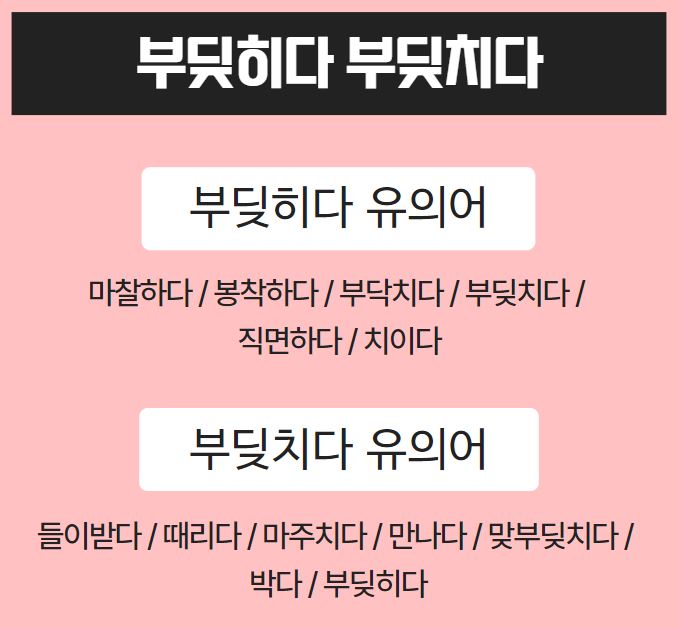
Do you know the exact meanings of these two words: budichhida (부딪히다) and budicheoda (부딪치다)? Knowing the difference not only makes you appear more knowledgeable, but using the right word in the right situation elevates the quality of your writing.
[Budichhida (부딪히다)] Synonyms: to clash / to encounter / to run into / to face / to collide / to be hit
*Related grammatical rule Budichhida is formed by attaching the passive suffix '-hi (히)' to the verb stem 'budida (부딪다)'. The stem is preserved in this derivation. It is used in expressions such as: 'running into financial difficulties (경영난에 부딪히다)', 'bumped into a friend in an alley (친구와 골목길에서 부딪혔다)', or 'ended up facing a difficult problem (어려운 문제에 부딪히고 말았다)'.
[Budicheoda (부딪치다)] Synonyms: to ram / to hit / to come across / to meet / to crash against / to collide with
*Related grammatical rule Occasionally one may see 'budichiida (부디치다)' written incorrectly — it is important to remember that the standard spelling is 'budicheoda (부딪치다)'. It is used in expressions such as: 'I want to avoid confronting him directly (그와 직접 부딪치는 건 피하고 싶다)', 'a bicycle crashed into a car on a rainy road (빗길에 자전거가 자동차와 부딪쳤다)', or 'it was done intentionally (고의로 부딪친 것이다)'.
In terms of spelling, neither word can strictly be called wrong. The difference lies in the situation in which each is used. To understand when each is appropriate, it helps to look at a bit of the underlying theory behind these two words.
Detailed Explanation
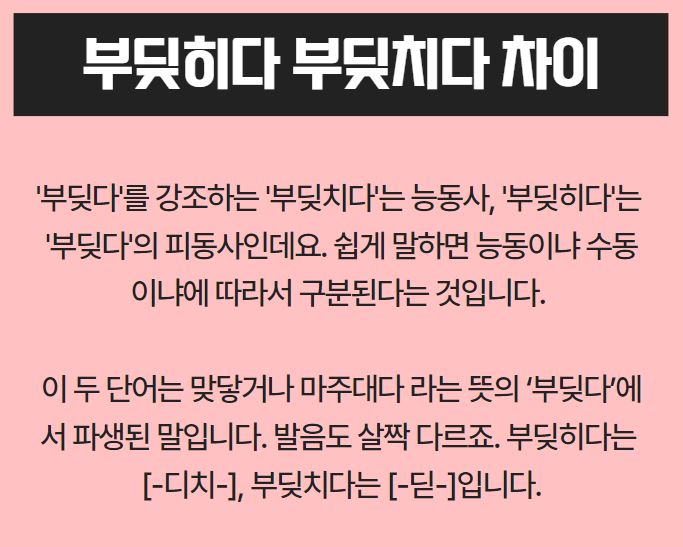
Understanding the Difference Between Budichhida and Budicheoda
'Budicheoda (부딪치다)' is the active (causative) form that emphasizes the action of 'budida (부딪다)', while 'budichhida (부딪히다)' is the passive form. In simple terms, the distinction comes down to active versus passive voice. Both words are derived from 'budida (부딪다)', meaning to collide or come into contact with something. Their pronunciations also differ slightly: budichhida is pronounced [-디치-], while budicheoda is pronounced [-딛-].
Because budicheoda contains the emphatic suffix '-chi (치)', it emphasizes the action performed by the subject. Budichhida, on the other hand, contains the passive suffix '-hi (히)', so it is used when the grammatical subject is not the agent of the action.
If the subject is on the receiving end of the collision, budichhida is appropriate. If the subject is actively performing the collision, budicheoda is used. While this may seem complex, the key is simply to choose whichever fits the intended meaning. However, distinguishing solely based on whether the subject has intent can sometimes be difficult. Let us look at some example sentences.
Practical Usage
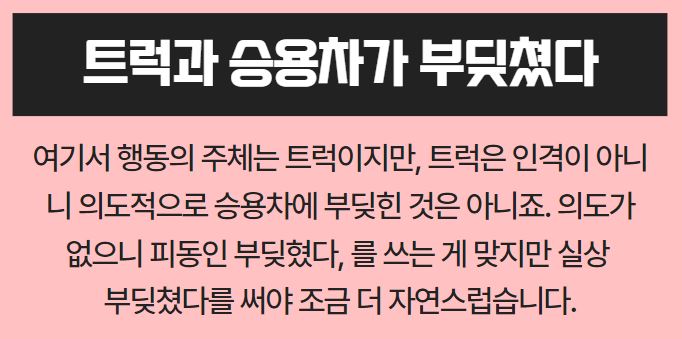
Understanding Through Real Examples
[A truck and a car collided (트럭과 승용차가 부딪쳤다)] Here the subject is the truck, but since a truck has no personhood, it did not intentionally collide with the car. Since there was no intent, one might think 'budichhida (부딪혔다)' — the passive form — would be correct, but in practice 'budicheoda (부딪쳤다)' sounds more natural.
A useful rule of thumb for such situations is as follows. Budichhida tends to be used for one-sided collisions — cases caused by accident or mishap. Budicheoda tends to be used for active or mutual collisions — when both sides are moving at the same time. Additionally, budicheoda is appropriate when the subject moves toward something and collides with it, or when two parties collide with each other. Budichhida is appropriate when something comes toward a stationary subject and hits it.
[My head hit the wall (머리가 벽에 부딪쳤다)] [I opened the door, hit my head, and fell (문을 열다 머리를 부딪쳐 넘어졌다)] [I slowed down because it seemed I was about to collide with a child (아이와 부딪칠 것 같아 속도를 줄였다)]
In all three situations, the subject ('I') is moving while the wall or door is stationary. Since the stationary object cannot suddenly move toward the subject, budicheoda is the appropriate form. The subject was already in motion, which is a key cue for using budicheoda.
Additional Information
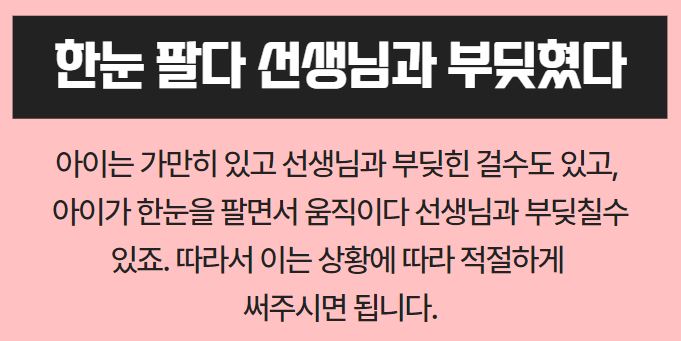
Situation-Dependent Usage of Budichhida and Budicheoda
[Distracted, I bumped into the teacher (한눈 팔다 선생님과 부딪혔다)] In this sentence, it is unclear whether the child was already moving or was standing still. It is possible that the child was stationary and the teacher walked into them, or that the child was walking without paying attention and bumped into the teacher. In such ambiguous cases, the appropriate form depends on the specific situation.
Understanding these situational differences allows for more accurate use of budichhida and budicheoda. Identifying the subject's movement and intent from context is key to selecting the right expression.
Summary: Correct Usage of Budichhida and Budicheoda
Today we explored the difference between budichhida (부딪히다) and budicheoda (부딪치다). While both words can be used in many situations, their meanings differ slightly, so it is best to choose the one that fits the context precisely.
A clear understanding of the active/passive distinction will help you produce more natural sentences, and using the right expression for the right situation will improve the effectiveness of your communication.
Key Checks First
When something collides or runs into something, Korean uses either 'budichhida' (부딪히다) or 'budicheoda' (부딪치다) — but do you know which one to use and when? Readers looking for Budichhida vs. Budicheoda: Korean Collision Verbs Explained usually need both the immediate steps and a fallback path when something fails. Use the checklist below before changing an account setting, submitting a request, or relying on a third-party guide.
Before You Start
| Item | What to check |
|---|---|
| Official channel | App, website, customer center, government site, or service portal |
| Verification | Login, phone verification, certificate, or two-factor authentication |
| Timing | Instant change, same-day processing, or business-day delay |
| Cost | Fee, auto-renewal, refund window, or cancellation condition |
| Records | Confirmation number, screenshot, email, or text message receipt |
Troubleshooting Order
- Recheck the current official app or website before following an old screenshot.
- If the menu name has changed, search inside the service with the core keyword.
- For verification errors, update the app, clear browser cache, and try another browser.
- For payment, refund, cancellation, or account deletion, save the completion screen.
- If support is needed, include the date, payment method, device, and exact error message.
Important Notes
Convenience services often change menu names, verification flows, and refund rules. Treat old screenshots as references, not final instructions. For irreversible actions such as cancellation, refund requests, account deletion, or official applications, confirm the current policy before pressing the final button.
For related everyday guides, browse the tips list. If the topic involves money, fees, interest, or taxes, the calculator hub can help with follow-up math. For policy or market updates, check the news section.
Frequently Asked Questions
Which should I follow if the app and website show different steps?
Use the current official screen for the service you are logged into. For payments, refunds, and cancellations, also check the latest terms or customer-center notice before final confirmation.
What should I do if verification keeps failing?
Update the app, try a different browser, clear cache, and retry phone or identity verification. If the same error repeats, save the message and contact support with the exact time and device.
What proof should I keep after completing the process?
Keep the confirmation number, completion screen, email, text message, and payment or cancellation record. These records help if you need to prove the request later.
Are older guides still reliable?
They can explain the general idea, but the current official page should be treated as the source of truth. Menu names and policies change, so confirm the latest screen before acting.
Additional Tips
- Consult a professional for accurate information
- For more details, please contact the relevant authority
Time calculators to use next
Continue with calculators for h:m:s arithmetic, work hours, sleep planning, presentation timing, and world time.
Apply this to your portfolio
Calculate the optimal weights with the rebalancing calculator
Go to Rebalancing CalculatorHave any questions?