What Is a Giant Step? Understanding Fed Rate Hike Terminology
If you have been following interest rate hikes and cuts, you may be wondering what a "Big Step" or a "Giant Step" means.
If you have been following interest rate hikes and cuts, you may be wondering what a "Big Step" or a "Giant Step" means.
Overview

These terms have been appearing frequently in economic news lately. Economic experts have indicated that the Federal Reserve's rate hikes could push the US economy into a recession. Recently, the United States made an exceptionally bold move for the first time in 28 years — since 1994. Last year, the Fed carried out a Giant Step rate hike, and further Big Steps remain possible going forward. Over the past three years, countries around the world lowered interest rates and waited to see how things would develop. As large amounts of money flowed into markets, the value of currency gradually declined while prices surged, leading to inflation. To understand the Giant Step — which seems to go one level beyond the Big Step — it helps to know the various "steps" associated with rate hikes and cuts: Baby Step, Big Step, Jumbo Step, Giant Step, and Ultra Big Step.
Detailed Explanation
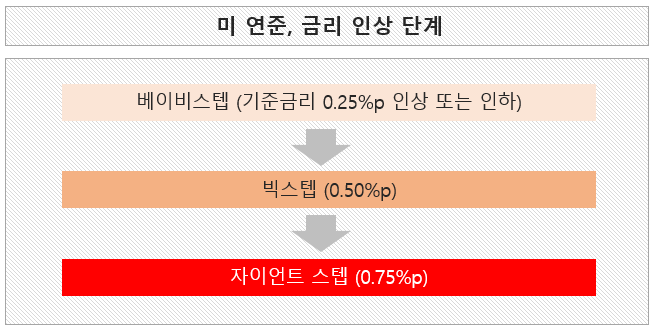
Let me explain each step one by one, starting from the beginning.
-
Baby Step This refers to a standard benchmark rate hike or cut of 0.25 percentage points. Because the rate moves only slightly, it has little direct impact on the real economy, but it is effective for adjusting economic activity and price levels. The name comes from the cautious, small movement — like a baby taking its first steps.
-
Big Step This refers to a benchmark rate hike or cut of 0.50 percentage points — twice the size of a Baby Step.
-
Jumbo Step A Jumbo Step refers to consecutive 0.50 percentage point hikes or cuts to the benchmark rate.
How It Works
-
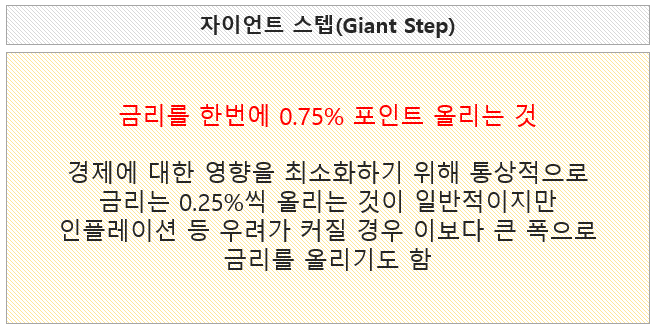
Giant Step A Giant Step refers to a 0.75 percentage point hike or cut in the benchmark interest rate. It is a far bolder and faster rate hike policy compared to a Big Step. From this level onward, the decision must be made with great care. Even a Big Step alone is enough to drain market liquidity and cause global stock markets to take a hit and decline. Of course, the Fed could also decide to cut rates again if inflation begins to fall, so keep in mind that the situation remains highly variable.
-
Ultra Big Step Also known simply as the "Ultra Step," this refers to a 1.0 percentage point hike or cut in the benchmark rate. It is generally considered very difficult to reach this stage.
Additional Information

South Korea currently sets its interest rates higher than the United States. However, if the US decides on another Big Step — or raises rates by even 0.5 percentage points — US rates could surpass those in Korea. In that case, foreign capital invested in South Korea may flow back to the United States, leading to economic slowdown and placing the full burden of household loan interest on individuals.
For this reason, it is worth keeping a close eye on South Korea's interest rate market as well. Analysts consider comprehensive factors such as the impact on the economy, exchange rates, and household interest burdens, but there is no denying that the situation gives cause for concern on many fronts.
In any case, now that we have covered the term "Giant Step" and its place in interest rate terminology, we hope this serves as an opportunity for you to pay closer attention to US–Korea economic news and to start planning your finances accordingly.
Key Checks First
If you have been following interest rate hikes and cuts, you may be wondering what a "Big Step" or a "Giant Step" means. Readers looking for What Is a Giant Step? Understanding Fed Rate Hike Terminology usually need both the immediate steps and a fallback path when something fails. Use the checklist below before changing an account setting, submitting a request, or relying on a third-party guide.
Before You Start
| Item | What to check |
|---|---|
| Official channel | App, website, customer center, government site, or service portal |
| Verification | Login, phone verification, certificate, or two-factor authentication |
| Timing | Instant change, same-day processing, or business-day delay |
| Cost | Fee, auto-renewal, refund window, or cancellation condition |
| Records | Confirmation number, screenshot, email, or text message receipt |
Troubleshooting Order
- Recheck the current official app or website before following an old screenshot.
- If the menu name has changed, search inside the service with the core keyword.
- For verification errors, update the app, clear browser cache, and try another browser.
- For payment, refund, cancellation, or account deletion, save the completion screen.
- If support is needed, include the date, payment method, device, and exact error message.
Important Notes
Convenience services often change menu names, verification flows, and refund rules. Treat old screenshots as references, not final instructions. For irreversible actions such as cancellation, refund requests, account deletion, or official applications, confirm the current policy before pressing the final button.
For related everyday guides, browse the tips list. If the topic involves money, fees, interest, or taxes, the calculator hub can help with follow-up math. For policy or market updates, check the news section.
Frequently Asked Questions
Which should I follow if the app and website show different steps?
Use the current official screen for the service you are logged into. For payments, refunds, and cancellations, also check the latest terms or customer-center notice before final confirmation.
What should I do if verification keeps failing?
Update the app, try a different browser, clear cache, and retry phone or identity verification. If the same error repeats, save the message and contact support with the exact time and device.
What proof should I keep after completing the process?
Keep the confirmation number, completion screen, email, text message, and payment or cancellation record. These records help if you need to prove the request later.
Are older guides still reliable?
They can explain the general idea, but the current official page should be treated as the source of truth. Menu names and policies change, so confirm the latest screen before acting.
Additional Tips
- Consult a financial professional for accurate and personalized advice.
- For more detailed information, please contact the relevant authorities or institutions.
Time calculators to use next
Continue with calculators for h:m:s arithmetic, work hours, sleep planning, presentation timing, and world time.
Apply this to your portfolio
Calculate the optimal weights with the rebalancing calculator
Go to Rebalancing CalculatorHave any questions?