Asperger Syndrome
Today I would like to talk about Asperger Syndrome. As I have been studying child psychology, I have come across many cases through various writings, and yesterday I came across an article about a child with Asperger Syndrome.
Today I would like to talk about Asperger Syndrome. As I have been studying child psychology, I have come across many cases through various writings, and yesterday I came across an article about a child with Asperger Syndrome.
Key Points
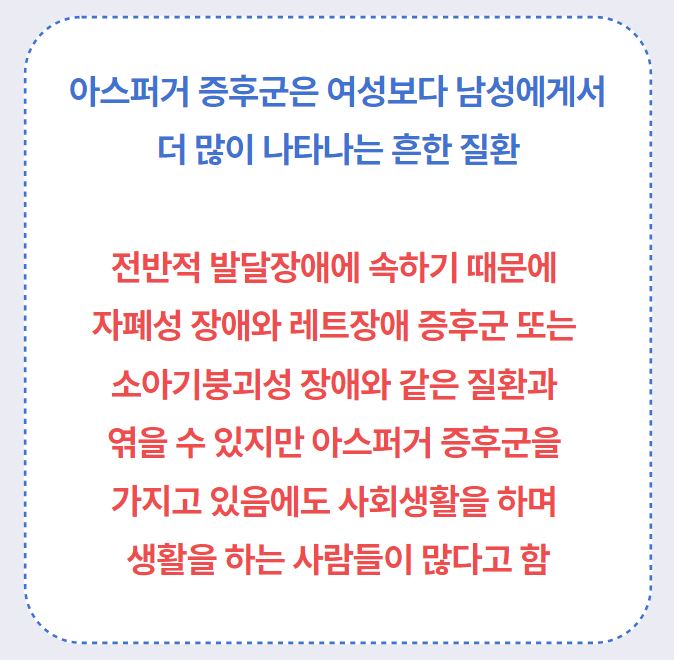
I felt that learning more about Asperger Syndrome would be of great help when counseling a child with the condition, so I looked into the information more carefully. It seems that many people are not well aware of this condition, so I wanted to share it in a post. Please read carefully if you would like to use this as a reference. What is Asperger Syndrome? I first encountered the term Asperger Syndrome in a novel some time ago. At the time, I simply thought "oh, there is such a condition" and moved on. However, it gained more attention recently when Elon Musk disclosed that he has Asperger Syndrome. Asperger Syndrome appears more frequently in males than in females, and it occurs in about ten out of every ten thousand people, making it more common than one might expect. Since it falls under pervasive developmental disorders, it is associated with conditions such as autistic disorder, Rett syndrome, and childhood disintegrative disorder. Nevertheless, many people with Asperger Syndrome are able to function in society and live relatively normal lives. Because it is a neuropsychiatric condition, it is known to be associated with delayed language development and difficulty adapting socially. People with Asperger Syndrome may also struggle to empathize with the experiences or feelings of others and can display stubborn behavior. However, they often show an obsessive focus on a single field they are interested in, and may even demonstrate exceptional genius in that area.
Detailed Explanation

This obsessive immersion in a single area of interest can sometimes manifest as exceptional talent. As a result, among those who excel in a particular field, quite a few appear to have Asperger Syndrome. What Causes Asperger Syndrome? The exact cause of Asperger Syndrome is not certain, but it is believed to result from a combination of physical factors. A significant proportion of patients are reported to have experienced brain damage during or shortly after birth, and many researchers believe there is also a connection to oxygen deprivation. In addition, individuals with Asperger Syndrome appear to have abnormalities in the efferent pathways of the cerebellum compared to those without the condition, making it difficult for the cerebellum's signals to be transmitted to the cerebrum. The symptoms are varied, but the most fundamental characteristic is difficulty with social interaction, making it hard to understand reciprocal behaviors or nonverbal communication with others. The symptoms of Asperger Syndrome are typically not identified before the age of three, and children usually begin speaking at a similar age to their peers. However, they tend to limit conversation topics exclusively to subjects they are personally interested in. Conversations may also revolve entirely around the individual themselves, and they may sometimes refer to themselves in the third person. When emotionally upset, they can express their feelings very intensely, whereas in other situations they tend to appear emotionally flat and expressionless.
Practical Guidance
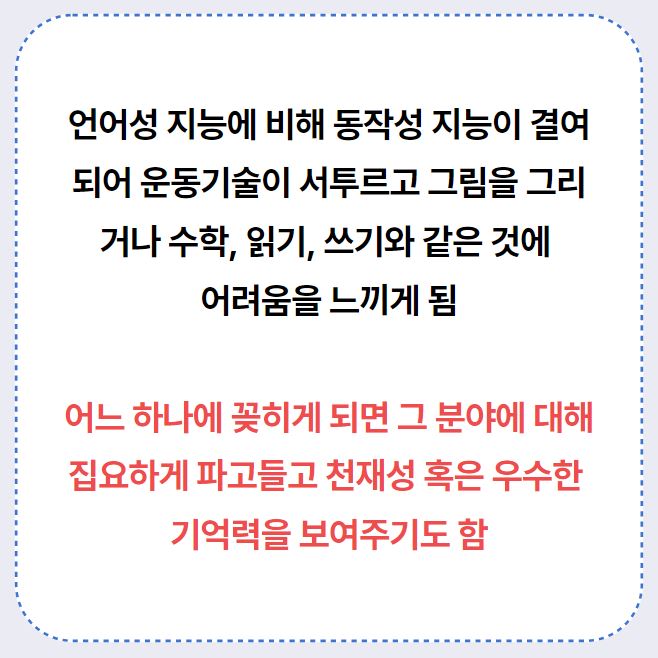
In general situations, their tone of voice and manner of speaking tend to be quite monotonous, their gestures are limited, and they may sometimes appear awkward or socially inappropriate. What Special Abilities Do People with Asperger Syndrome Have? In many cases, performance IQ is lower than verbal IQ, leading to difficulties with motor skills and with activities such as drawing, math, reading, and writing. In daily life, they often appear rigid and inflexible. Nevertheless, when they become deeply interested in something, they pursue it relentlessly and may demonstrate exceptional talent or remarkable memory in that domain. As a result, a notable number of individuals with Asperger Syndrome go on to become engineers, NASA employees, or even musicians with outstanding musical ability. Adult patients with Asperger Syndrome often also experience conditions such as anxiety disorders, anger management difficulties, or hwa-byung (a culturally specific stress syndrome), which can lead to comorbid conditions including digestive disorders, insomnia, or irritable bowel syndrome. If you suspect Asperger Syndrome, it is advisable to check whether the individual has difficulty making eye contact or engaging in social interactions in daily life, and to assess whether they struggle with forming peer relationships, sharing achievements with others, or maintaining emotional reciprocity. It is also recommended to seek treatment and support so that the individual can develop the skills needed to live independently.
Key Checks First
Today I would like to talk about Asperger Syndrome. As I have been studying child psychology, I have come across many cases through various writings, and yesterday I came across an article about a child with Asperger Syndrome. Readers looking for Asperger Syndrome usually need both the immediate steps and a fallback path when something fails. Use the checklist below before changing an account setting, submitting a request, or relying on a third-party guide.
Before You Start
| Item | What to check |
|---|---|
| Official channel | App, website, customer center, government site, or service portal |
| Verification | Login, phone verification, certificate, or two-factor authentication |
| Timing | Instant change, same-day processing, or business-day delay |
| Cost | Fee, auto-renewal, refund window, or cancellation condition |
| Records | Confirmation number, screenshot, email, or text message receipt |
Troubleshooting Order
- Recheck the current official app or website before following an old screenshot.
- If the menu name has changed, search inside the service with the core keyword.
- For verification errors, update the app, clear browser cache, and try another browser.
- For payment, refund, cancellation, or account deletion, save the completion screen.
- If support is needed, include the date, payment method, device, and exact error message.
Important Notes
Convenience services often change menu names, verification flows, and refund rules. Treat old screenshots as references, not final instructions. For irreversible actions such as cancellation, refund requests, account deletion, or official applications, confirm the current policy before pressing the final button.
For related everyday guides, browse the tips list. If the topic involves money, fees, interest, or taxes, the calculator hub can help with follow-up math. For policy or market updates, check the news section.
Frequently Asked Questions
Which should I follow if the app and website show different steps?
Use the current official screen for the service you are logged into. For payments, refunds, and cancellations, also check the latest terms or customer-center notice before final confirmation.
What should I do if verification keeps failing?
Update the app, try a different browser, clear cache, and retry phone or identity verification. If the same error repeats, save the message and contact support with the exact time and device.
What proof should I keep after completing the process?
Keep the confirmation number, completion screen, email, text message, and payment or cancellation record. These records help if you need to prove the request later.
Are older guides still reliable?
They can explain the general idea, but the current official page should be treated as the source of truth. Menu names and policies change, so confirm the latest screen before acting.
Additional Tips
- Please consult a specialist for accurate information
- For more details, please contact the relevant organizations
Time calculators to use next
Continue with calculators for h:m:s arithmetic, work hours, sleep planning, presentation timing, and world time.
Apply this to your portfolio
Calculate the optimal weights with the rebalancing calculator
Go to Rebalancing CalculatorHave any questions?