Normal Heart Rate for Adults
Hello. Heart rate is known to be very important.
지식iN 숫자 답변 뒤에는 증상과 재측정을 보세요
성인 정상 맥박수는 안정 시 보통 60~100회에서 시작합니다. 50대·60대 질문도 숫자 하나보다 증상, 평소 변화 폭, 불규칙 박동 여부를 함께 봐야 합니다.
- 50대·60대도 첫 기준은 안정 시 60~100회이고 약물·혈압·어지럼을 함께 봅니다.
- 맥박 100·120은 운동·카페인·발열·긴장 직후인지 먼저 나눕니다.
- 흉통, 숨참, 실신감, 심한 어지럼은 수치와 별개로 진료 신호입니다.
- 스마트워치 이상 알림은 손목 맥박 60초 측정과 함께 확인합니다.
Hello. Heart rate is known to be very important.
Key Points

It is also an important indicator that lets us know we are alive. Have you ever felt dizzy or anemic from a sudden rapid or slow heartbeat? It is said to be very important to periodically check whether your heart rate is within the normal range. Meanwhile, if your heart rate is different from usual, it seems you may need to check your health. Let us take a closer look at what the normal heart rate for adults is. What is a pulse? A pulse is known to refer to the periodic wave that appears in arteries following the heartbeat. For a normally healthy body, the pulse is said to appear consistently at a stable value. However, depending on various external or physical internal factors,
Detailed Explanation
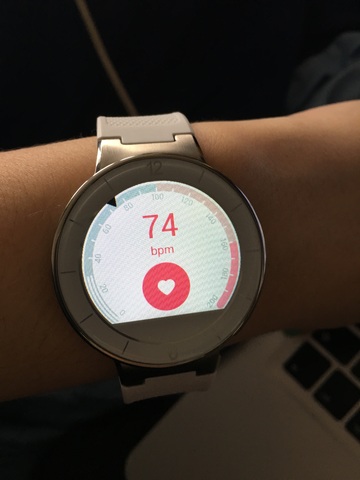
The strength or number of the pulse may change drastically. How to Measure Heart Rate It is understood that heart rate can be easily checked even without special medical equipment and even by non-experts. Counting the number of pulses per minute appears to help determine whether your heart rate is within the normal range. Of course, these days it is also easy to check your heart rate with a smartwatch, etc.
- It is good to place two fingers on the carotid artery (the artery on the side of the neck), radial artery, or wrist artery.
- You can quietly measure your heart rate for 1 minute using two fingers. It is generally recommended to measure your heart rate for 1 full minute. Meanwhile, if you find it difficult to concentrate due to a noisy environment or do not have enough time,
How to Use

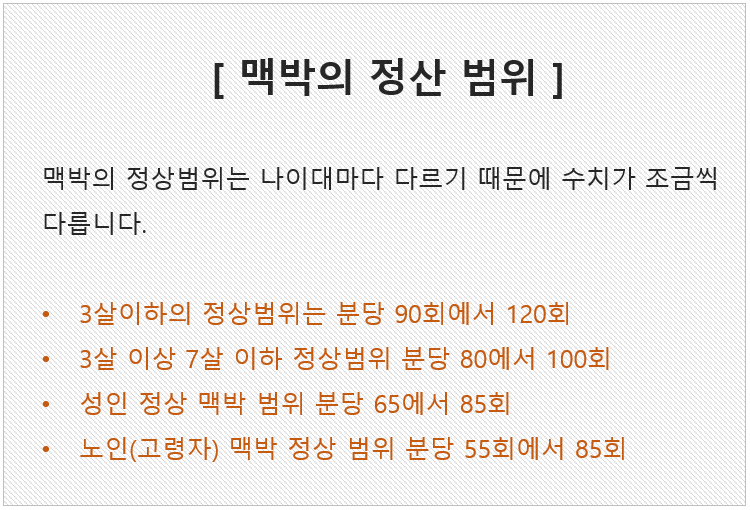
you can measure your heart rate for 10 seconds and then multiply by 6 to get the average heart rate. Normal Range of Heart Rate It is understood that the normal range of heart rate differs slightly depending on age. The normal range for children under 3 years old is known to be about 90 to 120 beats per minute. The normal range for children aged 3 to 7 years old is about 80 to 100 beats per minute. The normal adult heart rate range is reported to be about 65 to 85 beats per minute. The normal heart rate range for the elderly is said to be about 55 to 85 beats per minute. During infancy, heart rate is known to be higher due to the smaller body, and as one ages, the normal heart rate range gradually decreases due to reduced physical activity.
Additional Information

As explained above, the normal heart rate for adults is understood to be about 65 to 85 beats per minute. And it is known that it can be as high as 100 beats per minute. Heart rate may change due to special internal or external factors. When you are angry, excited, or exercising, it is said that it can temporarily exceed 100 beats per minute. When exercising, it is known to be good to keep the heart rate below about 75% of the maximum heart rate, which is 220 minus your age. (220 - age) x 0.75 Reasons for Heart Rate Fluctuation Even when things are normally fine, your pulse
In-Depth Content

rate may speed up or slow down for no apparent reason. In such cases, it may be a signal that something is wrong with your body, so it is said to be accurate to visit a hospital for a diagnosis. If your heart rate frequently exceeds 100 beats per minute, tachyarrhythmia may be suspected. Symptoms such as palpitations, a feeling of tightness in the chest, and dizziness are reportedly representative symptoms. Sudden chest pain may also occur. In severe cases, ventricular function may deteriorate and can even lead to death, so caution is advised. Meanwhile, a low heart rate may be considered bradycardia. Fatigue symptoms
Reference Notes
may increase, and fainting and dizziness can occur. Heart rate may drop below 60 beats per minute. In severe cases, respiratory difficulties can lead to cardiac or brain function failure. If the heart beats irregularly, it may be diagnosed as arrhythmia. This may occur after intense exercise, excessive caffeine consumption, or alcohol intake, in which case irregular results may appear. If your normally regular pulse shows abnormalities, it is recommended to visit a hospital for a health check. Differences in Pulse In general, pulse rate is known to be slower in men than in women.
7th Information

Activity is known to increase heart rate. However, the heart rate of athletes is actually slower than normal. This seems to be because their heart size, strength, and efficiency are greater than that of ordinary people. Meanwhile, regarding the relationship between pulse and body temperature, it is known that a rise in body temperature causes peripheral blood vessels to dilate. This results in an increase in pulse rate due to a drop in blood pressure. Additionally, regarding pulse and medication, it is understood that pulse is affected by medication. Cardiac glycosides are known to lower heart rate, and caffeinated drinks tend to increase it in many cases because they stimulate the sympathetic nervous system.
Key Checks First
Hello. Heart rate is known to be very important. Readers looking for Normal Heart Rate for Adults usually need both the immediate steps and a fallback path when something fails. Use the checklist below before changing an account setting, submitting a request, or relying on a third-party guide.
Before You Start
| Item | What to check |
|---|---|
| Official channel | App, website, customer center, government site, or service portal |
| Verification | Login, phone verification, certificate, or two-factor authentication |
| Timing | Instant change, same-day processing, or business-day delay |
| Cost | Fee, auto-renewal, refund window, or cancellation condition |
| Records | Confirmation number, screenshot, email, or text message receipt |
Troubleshooting Order
- Recheck the current official app or website before following an old screenshot.
- If the menu name has changed, search inside the service with the core keyword.
- For verification errors, update the app, clear browser cache, and try another browser.
- For payment, refund, cancellation, or account deletion, save the completion screen.
- If support is needed, include the date, payment method, device, and exact error message.
Important Notes
Convenience services often change menu names, verification flows, and refund rules. Treat old screenshots as references, not final instructions. For irreversible actions such as cancellation, refund requests, account deletion, or official applications, confirm the current policy before pressing the final button.
For related everyday guides, browse the tips list. If the topic involves money, fees, interest, or taxes, the calculator hub can help with follow-up math. For policy or market updates, check the news section.
Frequently Asked Questions
Which should I follow if the app and website show different steps?
Use the current official screen for the service you are logged into. For payments, refunds, and cancellations, also check the latest terms or customer-center notice before final confirmation.
What should I do if verification keeps failing?
Update the app, try a different browser, clear cache, and retry phone or identity verification. If the same error repeats, save the message and contact support with the exact time and device.
What proof should I keep after completing the process?
Keep the confirmation number, completion screen, email, text message, and payment or cancellation record. These records help if you need to prove the request later.
Are older guides still reliable?
They can explain the general idea, but the current official page should be treated as the source of truth. Menu names and policies change, so confirm the latest screen before acting.
Additional Tips
- Consult a professional for accurate information
- Please contact the relevant institution for more details
Time calculators to use next
Continue with calculators for h:m:s arithmetic, work hours, sleep planning, presentation timing, and world time.
Apply this to your portfolio
Calculate the optimal weights with the rebalancing calculator
Go to Rebalancing CalculatorHave any questions?