묻히다 vs 뭍히다 (Mudida vs Muthida)
I don't usually make many spelling mistakes, but there are quite a few words that confuse me when I'm texting friends on KakaoTalk or writing reports, so I often find myself searching for the correct spelling.
I don't usually make many spelling mistakes, but there are quite a few words that confuse me when I'm texting friends on KakaoTalk or writing reports, so I often find myself searching for the correct spelling.
Main Points
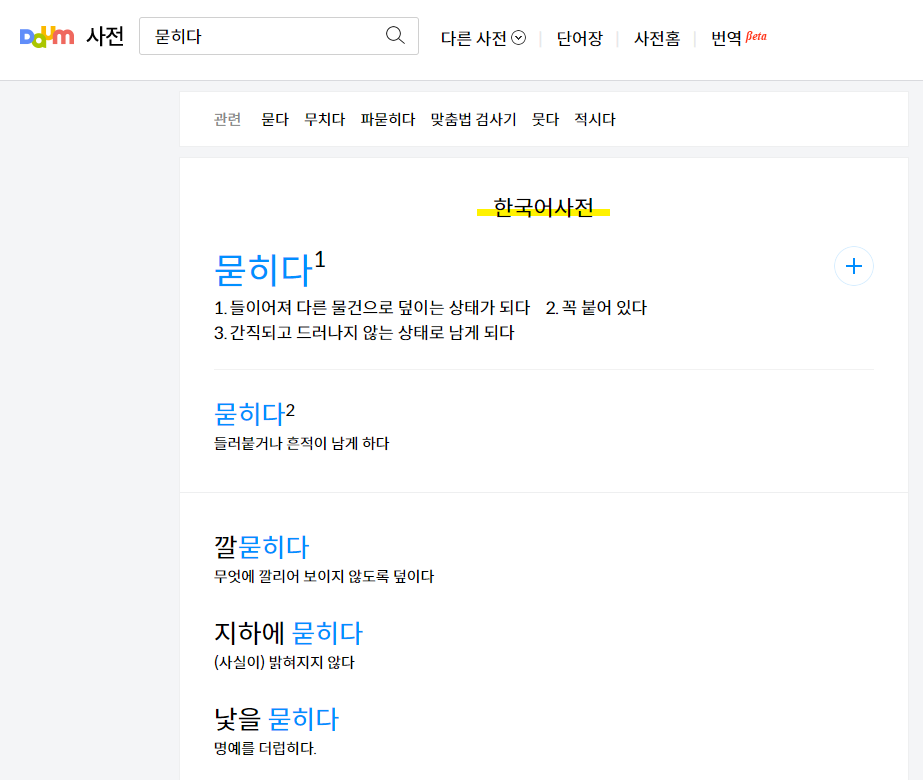
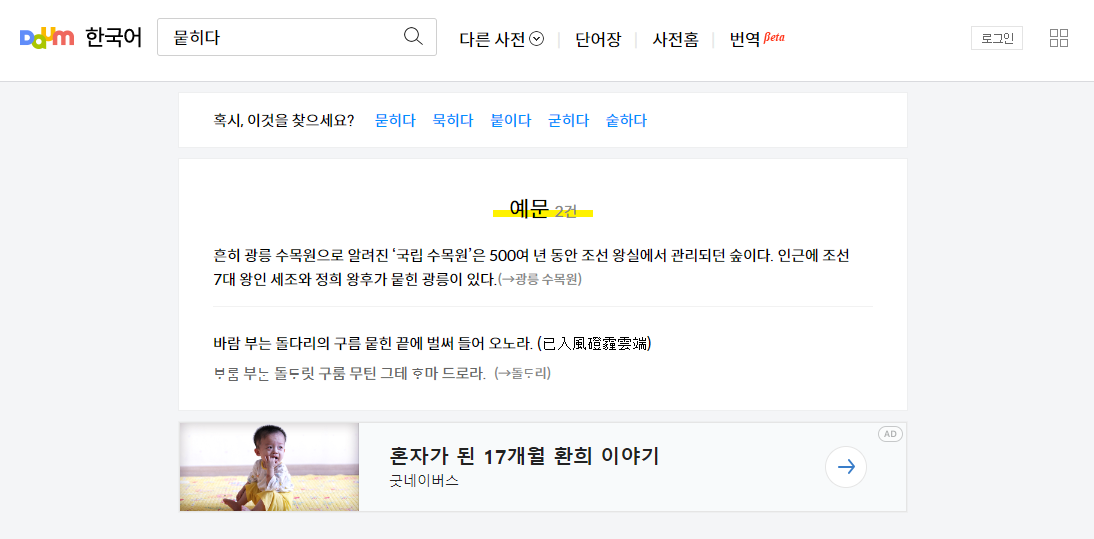
So this time I searched to find out about '묻히다' vs '뭍히다,' and while I was at it, I looked into other spelling confusions too — and I realized I had been using '묻히다' and many other words with incorrect spellings all along. But now that I know the correct forms, I plan to use accurate spelling and proper expressions going forward. First, for '묻히다' vs '뭍히다,' you can look at the base forms '묻다' and '뭍다.' Looking up the meanings of '묻다,' it means: to cover something with soil or another object so it cannot be seen; to lean deeply into something like a chair or blanket; to stick powder or paste onto another object; or to hide something deeply without revealing it. So it is used in expressions like 'smearing one's face with paint,' 'getting paint on clothes,' 'buried in the ground,' 'buried in darkness,' and 'wetting one's hand with water.' Now that we understand the meaning and examples of '묻히다,' we should also look at '뭍히다' — but this word simply does not exist. It was probably spread around by being mistakenly written due to its similar pronunciation to '묻히다,' and I felt embarrassed that I had been confusing myself over a word that never existed in the first place. Having found the correct form of '묻히다' vs '뭍히다' relatively quickly, I went on to look into other spelling issues. I searched to clarify the difference between '-데' and '-대,' which I had always hesitated over when writing reports. Many people seem to confuse these two since they sound almost identical, though apparently in standard speech they are pronounced differently too. It is said that the two have very different meanings, so they absolutely must be used distinctly. Of these, '-데' is used with the meaning of '-더라' or '-던가,' can be attached to both stems and endings, and is used when recounting something the speaker personally experienced in the past.
Detailed Explanation
'-대' is mainly used when conveying someone else's words, and any ending that can come before '-다' is acceptable. To illustrate the difference with examples: saying '어제 주사를 맞았더니 몸이 너무 아프데' (I got a shot yesterday and my body was so sore) uses '-데' to mean '-더라' (it really was), whereas '철수가 주사를 맞았는데 너무 아팠대' (Cheolsu got a shot and apparently it really hurt) uses '-대' to mean 'he said it hurt.' Next, I looked into '금새' vs '금세.' Many people mix these up, but the commonly used '금세' is a contracted form of '금시에,' meaning 'right now' or 'immediately.' So you cannot use '금새' with that meaning — but it is not a completely nonexistent word, so you can use it in its appropriate sense. Unlike '금세,' '금새' refers to the price or value of goods, so saying '금새도 모르고 저렴하다' means 'cheap compared to the current market price,' while '소문이 금세 퍼졌다' means 'the rumor spread quickly.' After learning about '묻히다' vs '뭍히다' and various other spellings, I was about to text a friend '언제든지' (anytime) on KakaoTalk, but suddenly wasn't sure if it should be '언제던지' — so I hesitated. So I also looked into '-든지' and '-던지.' The two feel even more confusing because they are both inserted between words, but since their meanings are completely different, I decided to properly learn them this time. First, '-든지' can be used when the listed items involve a matter of choice, and when attached to the stem of a verb or adjective it becomes an ending, while when attached to a noun or pronoun
How to Use
it becomes a particle. As for '-던지,' it is attached to the stem of verbs or adjectives — even knowing this, it was still hard to grasp right away, but learning that '-든지' is used when listing multiple facts, while '-던지' is used when talking about past events, made it much easier to approach. For example, in '밥을 먹던지 빵을 먹던지' (whether to eat rice or bread), where you are choosing between rice and bread, you should use '-던지'; but in '먹었든지,' since you are talking about something that happened in the past, you use '-든지.' There are many other confusing pairs like these, and one I used to mix up was '낫다' and '낳다.' Though it was when I was young, I remember being taught clearly by my parents exactly when each one should be used. For anyone who still doesn't know: '낫다' means to be better than or superior to something, or to recover from illness or injury back to normal; while '낳다' means to bring about a result, or to give birth to eggs or offspring from within the body. You can use them appropriately like: '감기가 낫는 것 같다' (the cold seems to be getting better) / '결과적으로 좋은 결과를 낳게 되었다' (it ultimately produced a good outcome). When used at the end of a sentence, '낫다' changes to '나아' due to irregular conjugation, while '낳다' changes to '낳아' due to regular conjugation — knowing this difference makes it easy to tell them apart. So I hope you now understand that '낫다' and '낳다' have completely different meanings. I also want to become someone who uses correct spelling going forward, so whenever a confusing spelling or expression comes up, I plan to look it up right away and use it correctly.
Key Checks First
I don't usually make many spelling mistakes, but there are quite a few words that confuse me when I'm texting friends on KakaoTalk or writing reports, so I often find myself searching for the correct spelling. Readers looking for 묻히다 vs 뭍히다 (Mudida vs Muthida) usually need both the immediate steps and a fallback path when something fails. Use the checklist below before changing an account setting, submitting a request, or relying on a third-party guide.
Before You Start
| Item | What to check |
|---|---|
| Official channel | App, website, customer center, government site, or service portal |
| Verification | Login, phone verification, certificate, or two-factor authentication |
| Timing | Instant change, same-day processing, or business-day delay |
| Cost | Fee, auto-renewal, refund window, or cancellation condition |
| Records | Confirmation number, screenshot, email, or text message receipt |
Troubleshooting Order
- Recheck the current official app or website before following an old screenshot.
- If the menu name has changed, search inside the service with the core keyword.
- For verification errors, update the app, clear browser cache, and try another browser.
- For payment, refund, cancellation, or account deletion, save the completion screen.
- If support is needed, include the date, payment method, device, and exact error message.
Important Notes
Convenience services often change menu names, verification flows, and refund rules. Treat old screenshots as references, not final instructions. For irreversible actions such as cancellation, refund requests, account deletion, or official applications, confirm the current policy before pressing the final button.
For related everyday guides, browse the tips list. If the topic involves money, fees, interest, or taxes, the calculator hub can help with follow-up math. For policy or market updates, check the news section.
Frequently Asked Questions
Which should I follow if the app and website show different steps?
Use the current official screen for the service you are logged into. For payments, refunds, and cancellations, also check the latest terms or customer-center notice before final confirmation.
What should I do if verification keeps failing?
Update the app, try a different browser, clear cache, and retry phone or identity verification. If the same error repeats, save the message and contact support with the exact time and device.
What proof should I keep after completing the process?
Keep the confirmation number, completion screen, email, text message, and payment or cancellation record. These records help if you need to prove the request later.
Are older guides still reliable?
They can explain the general idea, but the current official page should be treated as the source of truth. Menu names and policies change, so confirm the latest screen before acting.
Additional Tips
- For accurate information, consult a specialist.
- For more details, please contact the relevant authority.
Time calculators to use next
Continue with calculators for h:m:s arithmetic, work hours, sleep planning, presentation timing, and world time.
Apply this to your portfolio
Calculate the optimal weights with the rebalancing calculator
Go to Rebalancing CalculatorHave any questions?