International Age Calculator
I have many foreign friends, and whenever I travel abroad, I often meet new people and build meaningful connections.
만나이와 연나이는 계산식이 다릅니다
연나이 계산기 유입은 만 나이, 세는나이, 병역·청소년 기준이 섞입니다. 오늘 기준 숫자를 보는지, 특정 제도 기준일을 보는지 먼저 정해야 결과가 흔들리지 않습니다.
- 만 나이는 기준일에서 생일이 지났는지에 따라 달라집니다.
- 연나이는 기준연도에서 출생연도를 빼는 방식입니다.
- 청소년보호, 병역, 시험, 보험은 원문 기준일을 확인합니다.
I have many foreign friends, and whenever I travel abroad, I often meet new people and build meaningful connections.
Overview
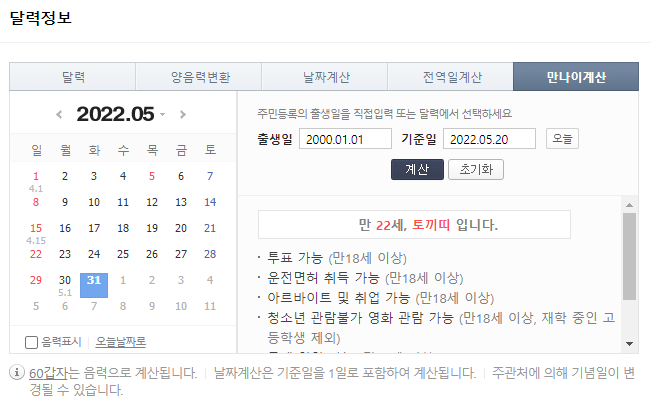
But whenever the topic of age comes up, I always find myself pausing to think about how to answer — and I usually end up giving my international age (man-nai). Since international age is the globally accepted standard, I naturally avoid using the Korean age system. The irony, however, is that even within Korea, international age, year-based age (yeon-nai), and counted age (seoneun nai) are all used interchangeably, which creates a great deal of confusion.
As most of you know, in Korea, a person is considered 1 year old the moment they are born, and gains another year on January 1st of each new year. This counted age system is deeply rooted in everyday life, yet legal documents and contracts typically require international age.
This inconsistency causes frequent confusion and inconvenience for ordinary citizens like myself. Korea's social and legal age calculation methods have long differed from the international standard. However, the government has announced plans to unify the system by adopting international age (man-nai) as the standard, which has led to a growing number of people turning to international age calculators to figure out their age.
Detailed Explanation
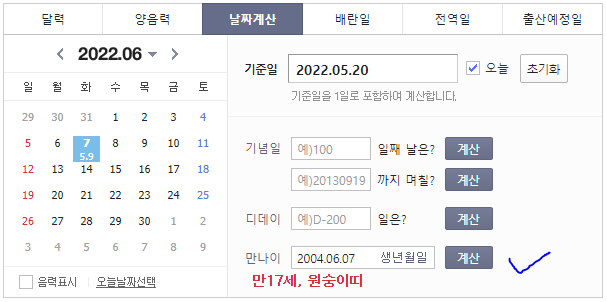
Many people have long felt the inconvenience of this system. The presidential transition committee also recognized that, given the lack of a unified age calculation standard, Korean citizens have faced ongoing disputes and confusion when using social welfare services, administrative services, or entering into various contracts — leading to unnecessary economic and emotional costs.
With the move to standardize international age, the goal is to eliminate these social and economic inefficiencies and relieve the confusion and inconvenience experienced in everyday life.
The transition committee has announced plans to establish international age calculation methods and notation rules within the Civil Act and the Framework Act on Administration. It also intends to solidify the principle of using international age in civil and administrative law, and to revise laws that currently use the year-based age system.
The adoption of international age is expected to bring significant convenience to daily life, minimize confusion in the delivery of administrative and medical services, and eliminate the awkwardness that arises in international contexts.
Practical Applications

Personally, I have encountered many inconveniences due to this age system in my daily life. One example was when I tried to use an age-restricted special clause for my car insurance — the policy terms clearly stated international age, but there was no separate explanation at the time of enrollment, which led to confusion.
Others have also experienced similar confusion in various situations. For instance, there has been ongoing confusion about the age threshold for wage peak systems at companies, as labor agreements often use year-based age while the Supreme Court applies international age. Similarly, during the COVID-19 vaccination rollout, some medical facilities mixed up international age and year-based age when determining eligibility, causing widespread confusion among the public.
Confusion also exists around the age requirements for military service and the age standards for youth-restricted establishments. It is hoped that adopting international age will reduce or eliminate these inconsistencies.
Currently, the easiest way to calculate your international age is to use an international age calculator. Without one, you can calculate it manually by subtracting your birth year from the current year.
Additional Information
When calculating manually, you must use your date of birth as listed on your resident registration. If the standardization to international age is officially enacted, most applications of counted age and year-based age are expected to disappear or diminish significantly.
To clarify the terminology: counted age (seoneun nai) is the traditional Korean system, where a person is considered 1 year old at birth regardless of the specific date, and gains a year on January 1st. Year-based age (yeon-nai) also adds a year on January 1st regardless of birthday, but starts from 0 at birth.
Note that year-based age will likely remain in use for laws prohibiting minors from purchasing alcohol and tobacco, so it will not be entirely eliminated. However, for most everyday services and contracts, international age is expected to become the standard.
Even after international age becomes the official standard, I suspect many people — myself included — will still default to giving their Korean counted age when introducing themselves for some time. It can feel strange to suddenly change a number you have identified with your whole life. But I look forward to the day when using international age becomes completely natural in everyday conversation.
Key Checks First
I have many foreign friends, and whenever I travel abroad, I often meet new people and build meaningful connections. Readers looking for International Age Calculator usually need both the immediate steps and a fallback path when something fails. Use the checklist below before changing an account setting, submitting a request, or relying on a third-party guide.
Before You Start
| Item | What to check |
|---|---|
| Official channel | App, website, customer center, government site, or service portal |
| Verification | Login, phone verification, certificate, or two-factor authentication |
| Timing | Instant change, same-day processing, or business-day delay |
| Cost | Fee, auto-renewal, refund window, or cancellation condition |
| Records | Confirmation number, screenshot, email, or text message receipt |
Troubleshooting Order
- Recheck the current official app or website before following an old screenshot.
- If the menu name has changed, search inside the service with the core keyword.
- For verification errors, update the app, clear browser cache, and try another browser.
- For payment, refund, cancellation, or account deletion, save the completion screen.
- If support is needed, include the date, payment method, device, and exact error message.
Important Notes
Convenience services often change menu names, verification flows, and refund rules. Treat old screenshots as references, not final instructions. For irreversible actions such as cancellation, refund requests, account deletion, or official applications, confirm the current policy before pressing the final button.
For related everyday guides, browse the tips list. If the topic involves money, fees, interest, or taxes, the calculator hub can help with follow-up math. For policy or market updates, check the news section.
Frequently Asked Questions
Which should I follow if the app and website show different steps?
Use the current official screen for the service you are logged into. For payments, refunds, and cancellations, also check the latest terms or customer-center notice before final confirmation.
What should I do if verification keeps failing?
Update the app, try a different browser, clear cache, and retry phone or identity verification. If the same error repeats, save the message and contact support with the exact time and device.
What proof should I keep after completing the process?
Keep the confirmation number, completion screen, email, text message, and payment or cancellation record. These records help if you need to prove the request later.
Are older guides still reliable?
They can explain the general idea, but the current official page should be treated as the source of truth. Menu names and policies change, so confirm the latest screen before acting.
Additional Tips
- For accurate information, consult a relevant professional.
- For more details, please contact the appropriate authority or institution.
Time calculators to use next
Continue with calculators for h:m:s arithmetic, work hours, sleep planning, presentation timing, and world time.
Apply this to your portfolio
Calculate the optimal weights with the rebalancing calculator
Go to Rebalancing CalculatorHave any questions?