Naero-nambul Meaning
You may have heard the term "naero-nambul" at least once. For those who are curious about its exact meaning, today we are going to take a closer look at what naero-nambul means. You may have also come across this word frequently while watching the news.
You may have heard the term "naero-nambul" at least once. For those who are curious about its exact meaning, today we are going to take a closer look at what naero-nambul means. You may have also come across this word frequently while watching the news.
Key Points

Because it consists of four syllables, many people assume it is a classical four-character idiom (saja-seong-eo), but naero-nambul is not a word that uses Chinese characters — except for the single character "bul" (不, meaning "not"). It is more accurately classified as slang, a neologism, or an abbreviation rather than a traditional idiom.
The meaning of naero-nambul comes from the phrase: "If I do it, it is romance (naemansu); if someone else does it, it is an affair (bullun)." It is formed by taking the first syllable of each key word, creating a four-syllable expression. In essence, it refers to a double standard — an act that would be criticized when done by others but rationalized when done by oneself.
As mentioned earlier, naero-nambul cannot be classified as a traditional four-character idiom, but there is a similar classical expression: "asitabi" (我是他非). This term means "I am right, and the other person is wrong."
Asitabi is also not an ancient classical idiom — it can be understood as a rendering of naero-nambul into Chinese characters. Notably, asitabi was selected as the "Four-Character Idiom of the Year" by professors, reflecting growing public interest in the concept.
The emergence of such a neologism suggests that in our daily lives, more and more people tend to think only in ways that benefit themselves, criticize others, and exhibit hypocritical and selfish behavior.
In social and professional settings, such individuals tend to be lenient with themselves while applying strict standards when criticizing the mistakes of others.
Detailed Explanation
Naero-nambul is also widely used in politics. The word was not used from the very beginning — it is said to have become popular among many people starting in the mid-to-late 1990s.
During that period, naero-nambul spawned many variations that became widely trendy, such as: "If I am ugly, it is individuality; if someone else is ugly, it is a sin by birth," "If I do it, it is entertainment; if someone else does it, it is gambling," and "If I drive that way, it is skilled driving; if someone else does, it is reckless driving." All of these variations share the same theme — justifying one's own behavior while criticizing others.
In psychology, naero-nambul is described as one of humanity's instincts. It can be viewed as a defensive behavior arising from the unconscious — a way of protecting oneself from the threat of self-image collapse when one has done something wrong.
To better understand naero-nambul, let us look at a few examples:
Examples of Naero-nambul
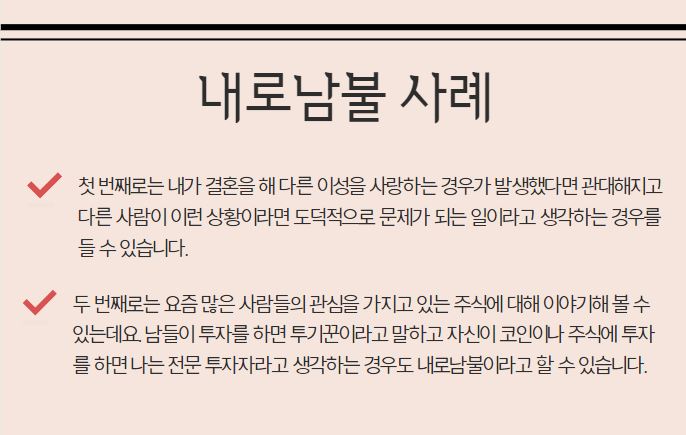
First, as mentioned earlier, if someone who is married falls in love with another person, they become lenient about it — yet if another person is in the same situation, they consider it a moral problem.
Second, regarding stocks and investments — a topic that many people are interested in these days: if others invest, they are called speculators, but if the same person invests in cryptocurrency or stocks, they consider themselves a professional investor. This is also a classic example of naero-nambul.
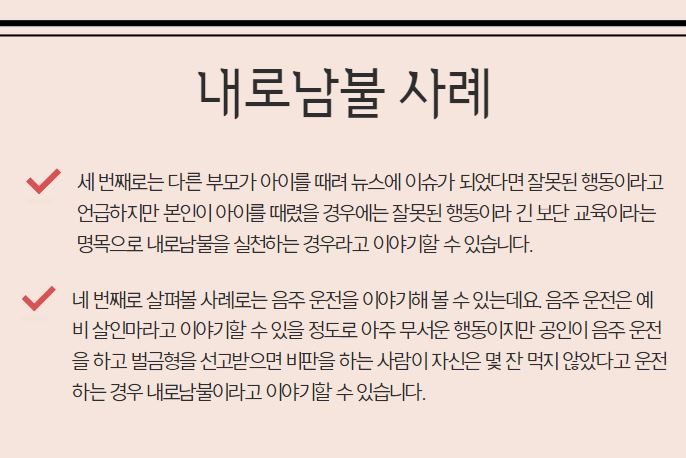
Third, if another parent hits a child and it becomes a news story, people say it is wrong — but if that same person hits their own child, rather than seeing it as wrong, they justify it under the name of discipline.
Fourth, drunk driving is another example. Drunk driving is an act so dangerous it could be likened to attempted murder. Someone who criticizes a public figure for drunk driving and receiving a fine may themselves drive after having just a few drinks — a textbook case of naero-nambul.
Looking around us, there are people who harshly criticize others while believing everything they themselves do is right and good. Such people often fail to recognize that their own behavior is flawed, and they continue to judge others by their own standards. It is generally best to keep your distance from such individuals.
Judging others with a double standard and viewing them negatively simply because they think differently from you is truly unacceptable behavior.
How to Apply This
Looking at those around us, there are people who harshly criticize others while believing that everything they do is right and proper. Such people often fail to recognize the flaws in their own character and continue to speak to others based solely on their own standards — which is why it is often better to keep your distance from them.
Judging someone with a double standard and viewing them negatively simply because they hold a different opinion is truly wrong behavior.
We hope today's explanation has helped you understand naero-nambul a little better.
Key Checks First
You may have heard the term "naero-nambul" at least once. For those who are curious about its exact meaning, today we are going to take a closer look at what naero-nambul means. You may have also come across this word frequently while watching the news. Readers looking for Naero-nambul Meaning usually need both the immediate steps and a fallback path when something fails. Use the checklist below before changing an account setting, submitting a request, or relying on a third-party guide.
Before You Start
| Item | What to check |
|---|---|
| Official channel | App, website, customer center, government site, or service portal |
| Verification | Login, phone verification, certificate, or two-factor authentication |
| Timing | Instant change, same-day processing, or business-day delay |
| Cost | Fee, auto-renewal, refund window, or cancellation condition |
| Records | Confirmation number, screenshot, email, or text message receipt |
Troubleshooting Order
- Recheck the current official app or website before following an old screenshot.
- If the menu name has changed, search inside the service with the core keyword.
- For verification errors, update the app, clear browser cache, and try another browser.
- For payment, refund, cancellation, or account deletion, save the completion screen.
- If support is needed, include the date, payment method, device, and exact error message.
Important Notes
Convenience services often change menu names, verification flows, and refund rules. Treat old screenshots as references, not final instructions. For irreversible actions such as cancellation, refund requests, account deletion, or official applications, confirm the current policy before pressing the final button.
For related everyday guides, browse the tips list. If the topic involves money, fees, interest, or taxes, the calculator hub can help with follow-up math. For policy or market updates, check the news section.
Frequently Asked Questions
Which should I follow if the app and website show different steps?
Use the current official screen for the service you are logged into. For payments, refunds, and cancellations, also check the latest terms or customer-center notice before final confirmation.
What should I do if verification keeps failing?
Update the app, try a different browser, clear cache, and retry phone or identity verification. If the same error repeats, save the message and contact support with the exact time and device.
What proof should I keep after completing the process?
Keep the confirmation number, completion screen, email, text message, and payment or cancellation record. These records help if you need to prove the request later.
Are older guides still reliable?
They can explain the general idea, but the current official page should be treated as the source of truth. Menu names and policies change, so confirm the latest screen before acting.
Additional Tips
- For accurate information, please consult a professional.
- For more details, please contact the relevant authorities.
Time calculators to use next
Continue with calculators for h:m:s arithmetic, work hours, sleep planning, presentation timing, and world time.
Apply this to your portfolio
Calculate the optimal weights with the rebalancing calculator
Go to Rebalancing CalculatorHave any questions?